
Plenty of websites stop after telling people who the company is, what it does, and how to get in touch. That is useful, but it is not the same as building a website around customer acquisition.
A strong lead generation website helps visitors recognize they are in the right place, understand why your offer fits, trust you enough to take the next step, and act without unnecessary friction. It also helps your team respond, qualify the opportunity, and see which marketing produced the lead.
The outcome is not more form submissions at any cost. It is more of the right customers, less time chasing poor-fit inquiries, and fewer good leads slipping through the cracks.
What a Lead Generation Website Actually Does
A lead generation website moves a visitor through four decisions: Am I in the right place? Can this business solve my problem? Do I trust them? What should I do next?
Am I in the right place?
Can you solve my problem?
Do I trust you?
What happens next?
The page that earns the visit should match what the person searched for, clicked, or was promised in an ad. The message should speak to a real need. The offer should make sense for that person. Proof should lower doubt. A clear call to action should point to one sensible next step. Lead capture should collect only what the business needs to continue the conversation.
Then the work continues after the form is submitted. The inquiry needs a fast acknowledgment, a useful next step, and a clear route into follow-up or a CRM. Tracking should connect the lead to its original page, search, ad, or campaign whenever those systems are configured.
That is why a lead generation website is more than attractive pages or a form in the footer. It is a connected conversion path.
Traditional Website vs. Lead Generation Website vs. Agentic Website
A traditional website can explain the business, show services, provide contact information, and reassure a prospect that the company is real. The difference is what the site is designed to make happen next.
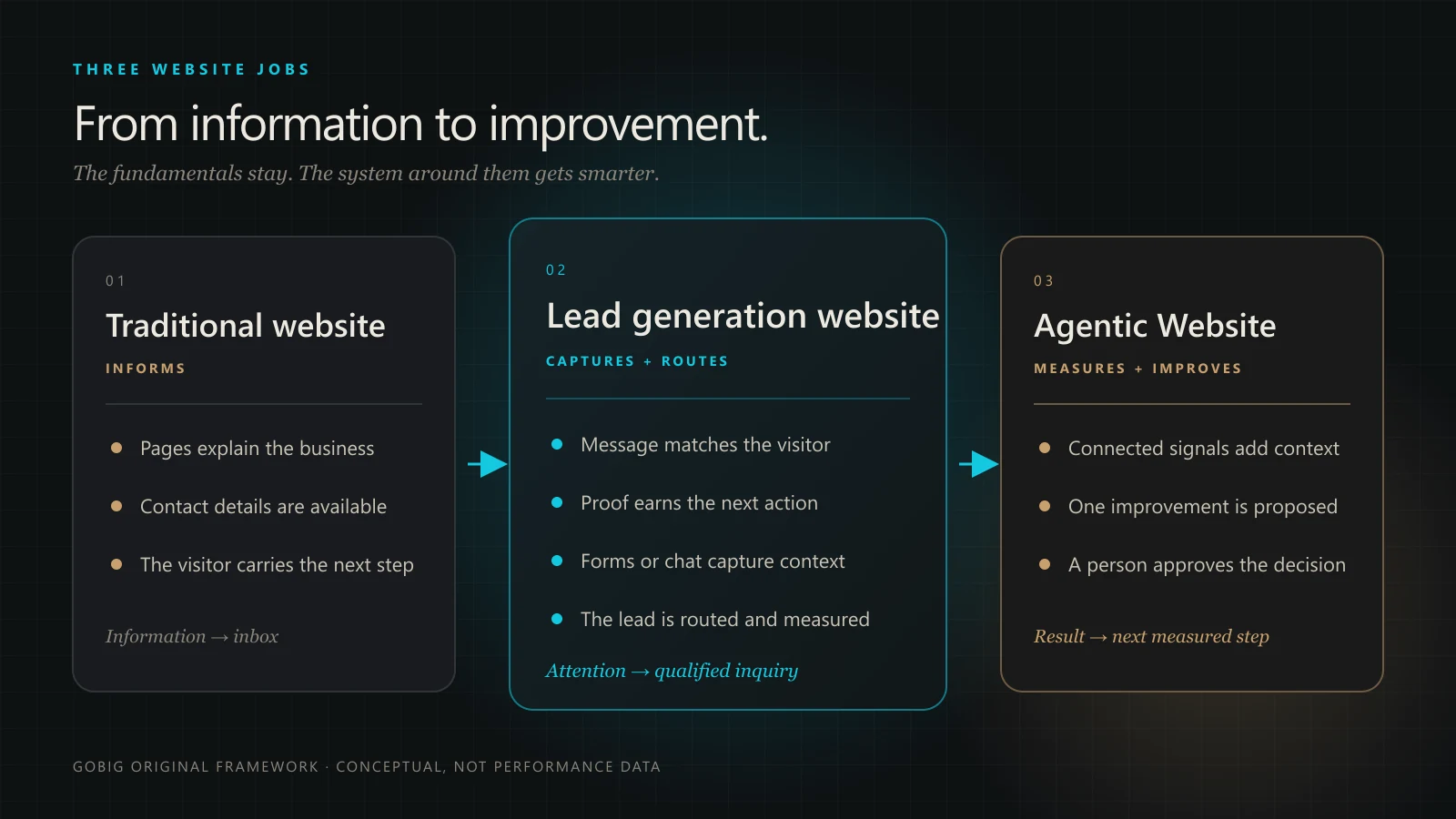
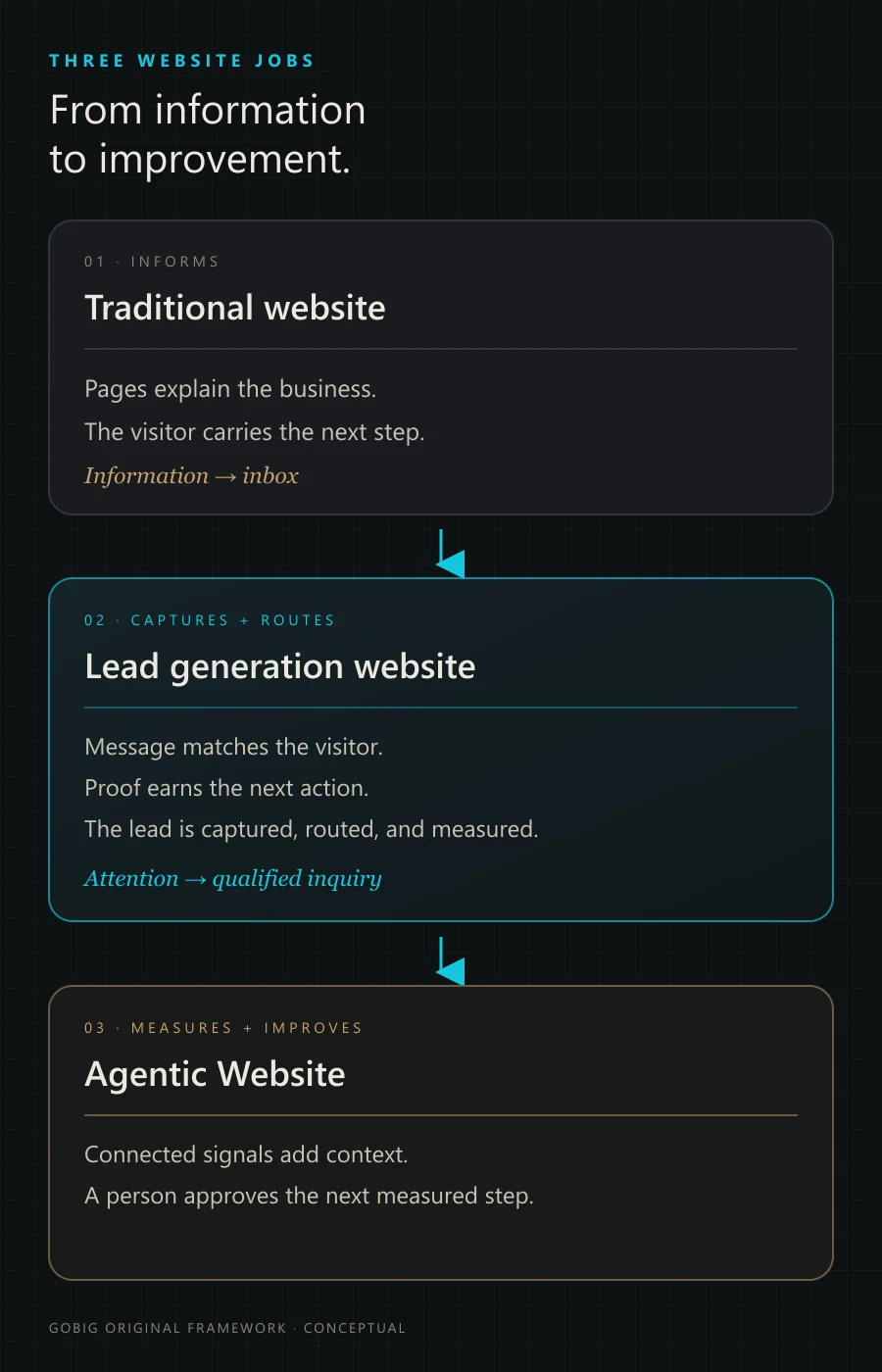
The middle option is the key shift. A lead generation website is built around action, not just information.
An Agentic Website takes that foundation further. When the right integrations are configured, the site can use approved business facts and prior results to support useful conversation, follow-up, and the next measured improvement. It does not replace the fundamentals. It helps the team operate them as one system.
For the category background, see what an AI-powered website actually does.
The Seven Parts of a Lead Generation Website
Conversion problems often come from several small gaps—the wrong message, vague proof, competing buttons, a long form, slow follow-up, or missing measurement.
Message match
The page fulfills the promise that earned the visit.
Clear offer
The right customer recognizes the problem and outcome.
Relevant proof
Evidence lowers doubt close to the decision.
Obvious action
One primary CTA makes the next step clear.
Useful capture
The form asks only for what the next step requires.
Qualification
Forms or conversation collect enough context to route well.
Follow-up + measurement
The business responds, tracks quality, and learns what worked.
Measurement returns evidence to the next decision
1. Message match
The visitor should immediately see the connection between what earned the click and what the page says. Google describes landing-page experience through signals such as usefulness, relevance, ease of navigation, and whether the page meets the expectation created by the ad. (Google landing-page guidance) Google separately recommends a clear CTA, differentiation, mobile friendliness, and message match. (Google optimization guidance)
2. A clear offer for a clear audience
A page cannot persuade everyone at once. The visitor needs to understand what you provide, who it is for, what problem it solves, and what outcome they can reasonably expect. Specific language helps the right prospect recognize fit and gives the wrong prospect a reason to move on. A lead engine should improve inquiry quality, not merely inflate the count.
3. Proof that lowers risk
Visitors need something they can evaluate: project photos, product demonstrations, process details, sourced reviews, certifications, team experience, clear ownership, or results you have permission to publish. Put proof close to the claim it supports. For businesses with something worth showing, the finished work, product, place, or transformation should do real selling.
4. One obvious CTA
A clear CTA tells the visitor what to do and what happens next: request an estimate, check availability, get a recommendation, book a consultation, or start a project. You can offer secondary paths, but five competing buttons make the visitor carry the decision burden.
5. Low-friction lead capture
Ask only for information you will use at that stage. The form should work well on a phone, explain the next step, handle errors clearly, and route the information somewhere the business will see it. W3C’s accessibility guidance also recommends visible labels that clearly describe each control and connect programmatically to the right field. (W3C form-label guidance)
6. Qualification and conversation
Not every visitor is ready for a form. Some have one specific question or do not know which service fits. A custom AI chatbot that qualifies visitors through conversation can help when it is grounded in the real business, uses approved answers, gathers useful context, and hands off accurately. The goal is not to disguise a bot as a salesperson. It is to make the next step easier while keeping human judgment where it matters.
7. Follow-up and measurement
While the visitor’s intent is still fresh, confirm receipt, explain the next step, alert the right person or workflow, preserve the visitor’s context and source, and record whether the lead became qualified, booked, sold, or lost. Measurement closes the loop: without it, you may know that forms were submitted but not which pages or messages produced customers.
Test Your Lead Generation Website in 10 Minutes
You do not need a dashboard to find the first broken handoff. Walk through your current site like a real prospect and verify the complete path instead of judging the design from the homepage.
Arrive like a customer
Open the page from a real search, ad, email, or referral link on your phone. Confirm the first screen matches the promise and offers one clear action.
Complete the action
Submit the form, start the chat, or book the appointment. Note every confusing field, error, delay, and competing button.
Verify the handoff
Confirm that the information persists, reaches the right inbox or CRM, and gives the visitor an accurate acknowledgment.
Name the owner
Identify who responds, what context they receive, and what happens when the first attempt does not connect.
Trace the outcome
Check whether you can connect the inquiry to its source and record whether it became qualified, booked, sold, or lost.
A polished lead generation website can still lose the opportunity when the path breaks between the first promise and the actual follow-up.
How an Agentic Website Takes Lead Generation Further
A conventional lead generation website is usually improved at specific moments. Someone reviews performance, changes a page, launches a campaign, or checks a report.
An Agentic Website can make that work more connected. When the right sources are configured, it can use website behavior, search, forms, conversations, and customer outcomes to help the team choose one worthwhile improvement. The system drafts or builds the change, a person reviews consequential decisions, and the result is measured before the next move.
The practical difference is that the site remembers approved business facts and prior results instead of starting from scratch. A real self-improving business loop reads the prior result before choosing the next measured step. The value is less owner coordination and a customer path that becomes easier to understand and improve—not AI for its own sake.
Lead Generation Website Checklist
A lead generation website does not need every possible feature. It needs the right path for your buyers, a dependable handoff to the business, and enough measurement to know what deserves improvement.
The first screen says what you offer, who it is for, and why it matters.
Important pages match the search, ad, email, or link that brings visitors there.
Each conversion-focused page has one unmistakable primary action.
Relevant proof appears near the claims and decisions it supports.
A mobile visitor can comfortably read, navigate, and complete the next step.
Lead capture asks only for information the business will use.
Visitors can get useful answers before they are ready to submit a form.
Every submission reaches a verified inbox, CRM, or workflow.
The visitor receives a clear acknowledgment and knows what happens next.
Your team can see the page, search, ad, or campaign that produced the lead.
You measure qualified opportunities and customers—not only form fills.
Someone owns the job of reviewing results and improving the conversion path.
Lead Generation Website FAQ
What is a lead generation website?
A lead generation website is designed to attract potential customers, build enough trust for them to act, capture useful information, and connect the inquiry to qualification, follow-up, and measurement.
What is the difference between a lead generation website and a traditional website?
A traditional website mainly presents information. A lead generation website organizes that information around a conversion path, guiding the right visitor toward an inquiry and connecting that inquiry to a dependable next step.
What pages does a lead generation website need?
Most businesses need a strong homepage, focused service or product pages, relevant proof or project pages, an about page that establishes trust, a clear conversion page, and targeted landing pages for important campaigns or search needs.
Can an existing website be improved for lead generation?
Yes. Many sites can improve by clarifying the message, strengthening proof, simplifying CTAs and forms, fixing mobile friction, verifying delivery, connecting follow-up, and measuring qualified outcomes before considering a complete rebuild.
How does an Agentic Website generate leads?
An Agentic Website uses the same lead-generation fundamentals, then connects them to useful conversation, follow-up, and measurement. When configured, it remembers approved business facts and prior results so the team can choose the next measured improvement.
Your website should create a clear path from attention to customer.
A good-looking website can still leave the owner wondering where the customers are. A lead generation website earns its place by helping the right people find you, understand your value, trust the business, take a clear next step, and receive a timely response.
The strongest version connects that journey to qualification and measurement so you can improve more than the page—you can improve the entire path from traffic to customer.