
That's not a fantasy. It's the difference between bolting AI onto old habits and actually building an AI-powered business. And the gap between those two things — for small business owners specifically — is now worth real money.
This article explains how AI agents for small business create a compounding feedback loop: a system where your marketing, website, and customer follow-up get a little better every single week, mostly without your involvement. We'll keep the tech jargon to a minimum and focus entirely on what this means for your revenue.
Why “Using AI” Isn't the Same as Having an AI-Powered Business
There's a word you'll hear a lot: copilot. A copilot tool is something you still have to fly yourself — like a smarter search box. You ask it to write an email, it writes the email, you send the email. Useful. But you're still doing the work. The AI is just your assistant.
An AI agent is different. An AI agent is software that makes decisions and takes action on its own, the way an employee would — not a tool you operate, but a worker you delegate to. You tell it the goal. It figures out the steps, executes them, checks the results, and adjusts. You review the output. The agent runs the process.
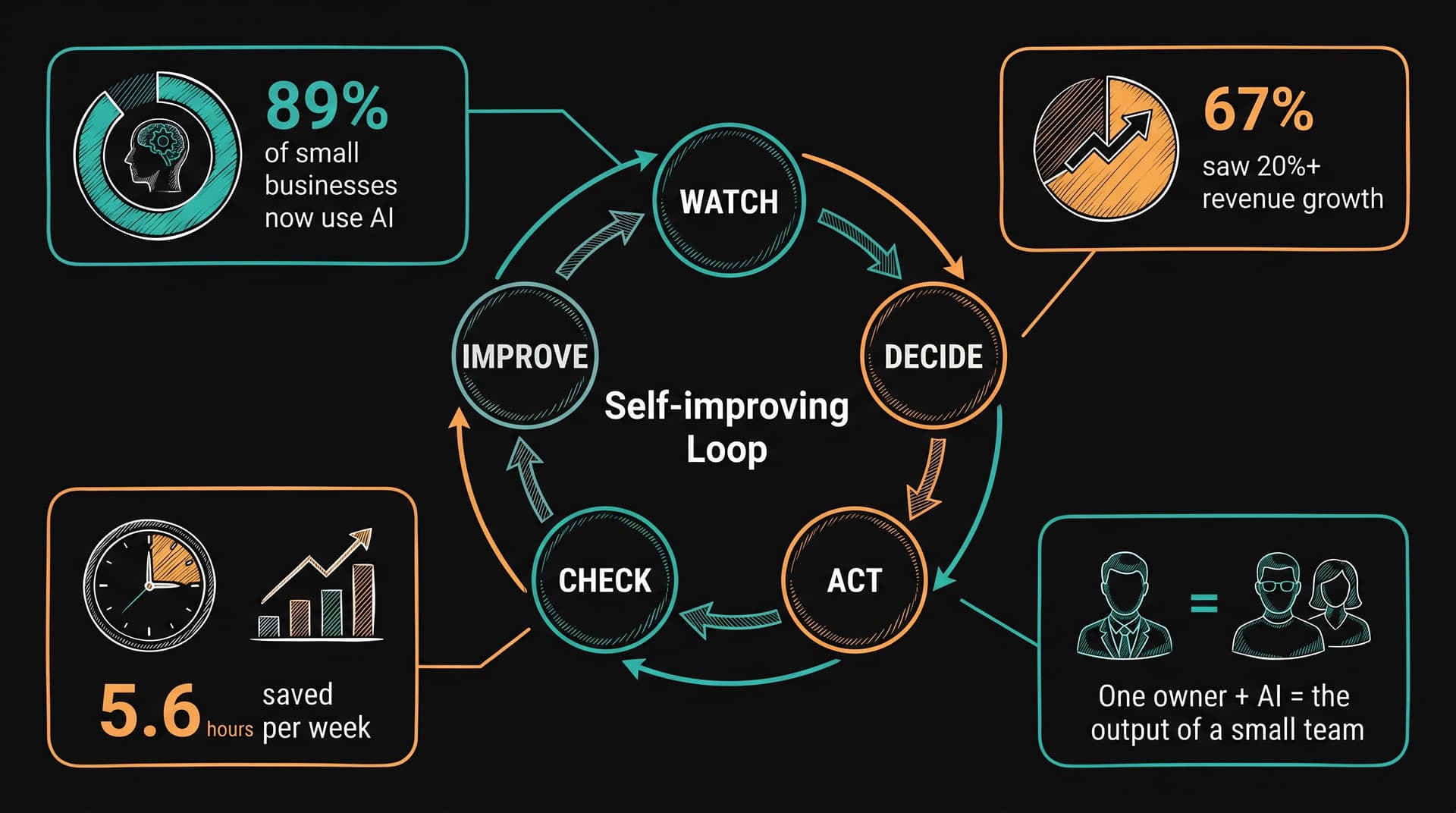
According to the SBE Council's 2026 Small Business Tech Use Survey, 89% of small businesses now use AI in some form. Most of them are using it like a calculator — one-off prompts, manual copy-paste, scattered tools that don't talk to each other. That's the bicycle with the jet engine.
The businesses pulling ahead have done something structurally different. Instead of a rigid chain of command where information passes up and down between humans — like a Roman legion where every decision needs a general — they've built a system where AI agents handle the repeatable decisions automatically, and humans show up for the high-stakes moments that actually need a person. The result is a business that doesn't need to wait for Monday morning.
The Feedback Loop That Makes Your Business Smarter Every Week
Here's the core idea, translated out of tech-speak: a recursive self-improving loop — your business quietly doing its own homework and correcting its own mistakes, over and over, without you running every play.
It works like this. Five steps, cycling continuously:
- 1Watch — The AI monitors what's happening on your website. Which pages get visitors. Which ones get clicks. Which ones get nothing.
- 2Decide — Based on what it sees, it identifies the weakest link. Maybe your pricing page headline isn't converting. Maybe your ad is sending people to the wrong landing page.
- 3Act — It drafts a revised version and queues it for a human to approve. Or in some cases, it runs a small test on its own.
- 4Check — It tracks results from the change. Did more people call? Did more people fill out the form?
- 5Improve — It keeps the winner. Discards the loser. Moves on to the next weakest link. Then the loop starts over.
Every week this runs, your business gets slightly better at converting visitors into leads. Slightly better at turning leads into customers. Slightly better at retaining the customers you have. Compounded over months, that's not slight at all.
The data backs this up. A Salesforce survey of 3,350 small and midsize business leaders found that 91% of SMBs using AI say it directly boosts their revenue. The gains are real — and they're driven by businesses that built the loop, not just bought the tools.
This is what GoBig calls the Compounding Loop. The same AI brain builds the ads, the landing page, the tracking, and the email follow-up — so it can optimize the whole chain together. Not one channel at a time. Each week it sees which combination converts best and rewrites the losers. That's the real-world version of the self-improving loop.
The key piece that makes all of this work — and the part most small business owners skip entirely — is the website itself. Not a static online brochure that sits unchanged until your next redesign, but an agentic website: a site that acts on its own, rewriting its own copy and testing its own headlines based on live performance data, not on whoever last logged into the CMS.
This is the cornerstone. Your agentic website is the hub the whole loop runs on — it's where most businesses start building a self-improving system, and everything else plugs into it. The ads point to it. The follow-up emails fire from it. The customer data flows back into it. Your website stops being a one-time expense and becomes the engine that compounds.
The Hidden Asset Most Small Businesses Are Already Sitting On
Here's something counterintuitive: the most valuable ingredient in an AI-powered business probably already exists in yours. It's sitting in your old emails, your customer call notes, your Google reviews, your service descriptions, and your brain.
That collection of knowledge — your business history, brand voice, what customers ask, what objections you hear, what makes your service different — is what we call a business knowledge base. Think of it as a living document the AI reads every time it writes an ad or answers a customer, so it sounds like you, not a generic robot.
Why this matters more than the software:
Your competitors can sign up for the same AI tools you use — they're available to everyone. They cannot buy five years of your customer patterns, your hard-won product knowledge, or your brand voice. Software is throwaway. Your context is the asset.
Once that knowledge is structured and connected to the AI system, every piece of output — ads, emails, web copy, chatbot responses — reflects your actual business. Not a generic version of your category. That's the difference customers feel, even if they can't name it.
There's also a financial argument here. McKinsey's research on agentic organizations shows that AI-native firms dramatically outperform on revenue per employee. For a solo owner, a $200–500/month AI stack can effectively stand in for 2–3 marketing and admin hires — versus $120,000+ in salaries. That math changes everything about what's possible for a one-person operation. The phrase worth keeping: burn tokens, not headcount. You pay for AI usage, not for salaries.
What “Hands-Off” Actually Means (and Doesn't)
“Hands-off” doesn't mean you disappear. It means you move from doing the work to deciding what matters. You're the captain. The AI is the engine room running 24/7.
Humans stay at the edge — the high-stakes, high-emotion, in-person moments that actually require a person. Big proposals. Upset customers. Creative pivots. Relationships that took years to build. Those stay yours. The AI runs the repeatable 80%: the follow-up sequences, the ad variations, the landing page rewrites, the monthly performance reports.
According to the SBE Council's 2026 report, the average employee saves 5.6 hours per week with AI tools. Managers average 7.2 hours. For a small business owner wearing five hats, that's a full workday back — every week.
At GoBig, done-for-you AI marketing means GoBig's experts judge and approve what the AI generates. The owner doesn't babysit the system. They show up for the moments that only a human can handle.
How to Tell If Your Business Is Ready
No tech team required. No coding. No complicated setup on your end. Here's a non-technical checklist. Answer yes or no to each question:
- □Do you have a website? (Even a basic one counts.)
- □Do you get leads online — from Google, social, or your site?
- □Do you send follow-up emails or texts to prospects or customers?
- □Do you run any paid ads, even occasionally?
- □Do you have any customer reviews, call notes, or sales emails you could share?
If you answered yes to 2 or more: you're ready. The AI reads what you already have, builds your knowledge base from it, and the loop starts from there.
The typical starting point is the agentic website. The AI reads your existing site, your reviews, and any sales materials you have, then builds the knowledge library — your brand voice, service descriptions, and customer language. That becomes the foundation for a website that can rewrite and improve itself. From there, the rest of the loop plugs into the hub: an ad, a landing page, a follow-up sequence, and the tracking that connects them all.
From week one, data starts coming in. From week two, the loop starts optimizing. Not perfect immediately — but improving continuously. That's the point. To get a concrete sense of what this means for your specific business, the Chatbot ROI Calculator is a good first step to put real numbers on what automation could save you. For the full connected-channel picture — where ads, landing pages, and email all optimize together — that's what Nova's team of AI marketing agents is built to deliver.
Frequently Asked Questions
What are AI agents and how are they different from chatbots?
A chatbot waits for someone to ask it a question, then responds. An AI agent — software that makes decisions and takes action on its own, the way an employee would — actually goes out and does things: writing ad copy, analyzing your website performance, sending follow-up emails, flagging what's underperforming. A chatbot is reactive. An agent is proactive.
Can a small business with no tech team actually use AI agents?
Yes — that's the point of the done-for-you model. You don't configure anything. GoBig's team sets up the system, connects the tools, and manages the loop. Your job is to review outputs and approve major decisions. No coding, no dashboards to learn, no ongoing technical management on your end.
How long does it take for an AI system to start improving my business results?
Most businesses see measurable shifts within 60–90 days. The first month is setup and baseline: the AI reads your existing assets, builds the knowledge library, and launches the first version of your loop. Month two and three are where optimization kicks in — the system has enough data to start making meaningful improvements to what's converting and what isn't.
How much does it cost to run an AI-powered marketing system for a small business?
GoBig's AI-Native Business OS starts at $500/month. That covers the knowledge library setup, the connected marketing loop (ads, landing page, tracking, email), and ongoing optimization. Compare that to hiring even one part-time marketing employee — typically $40,000–60,000 per year — and the economics are clear. You're paying for AI usage (tokens, the fuel AI runs on) rather than salaries.
What is an agentic website and why is it different from a regular website?
A regular website is a brochure. It says what you say on the day someone built it, and it stays that way until someone manually updates it — which usually means never, or once a year. An agentic website — one that lives inside the AI feedback loop — actually rewrites its own copy based on what's converting. The headline that's losing gets replaced. The section that's winning gets expanded. The site gets better while you sleep, not just when you have budget for a redesign.
The Bottom Line
Here's the real difference between the businesses that thrive in the next five years and the ones that stay stuck: one of them built a system that improves itself every week. The other is still manually updating their website and hoping someone calls. While you read this, there are small business owners whose ads got a little better, whose landing page headline just got swapped for a version that converts higher, and whose follow-up email went out automatically to a lead that came in at midnight.
Your competitors — the ones who are still changing the oil on a horse cart — haven't figured this out yet. That window won't stay open forever.
Ready to Build a Business That Improves While You Sleep?
GoBig sets up the entire AI-Native Business OS for you — knowledge library, connected marketing loop, agentic website — starting at $500/month. No tech team required. You run your business. We run the loop.