Everyone Says "AI-Native." Almost Nobody Is.
The gap between perception and reality in business AI adoption is striking. According to McKinsey's 2025 State of AI report, 88% of companies report using AI in at least one business function. Only 6% qualify as AI "high performers" — organizations actually achieving significant, measurable returns from their investment.
That's an 82-point chasm. And it isn't a technology gap. It isn't a budget gap. It's a structural gap. The 88% are doing something real — running AI tools, using generative features, experimenting with automations. The 6% built something fundamentally different: a company that agents can actually operate inside of.
What separates those two groups is what the rest of this article is about.
The Real Definition: A Company a Machine Can Read
Here's a working definition worth keeping: an AI-native company is one that is machine-legible. Its processes are documented clearly enough for a system to execute them. Its decision rules are written down, not implied. Its data is structured, not scattered. Its institutional knowledge lives in a retrievable layer, not in two people's heads.
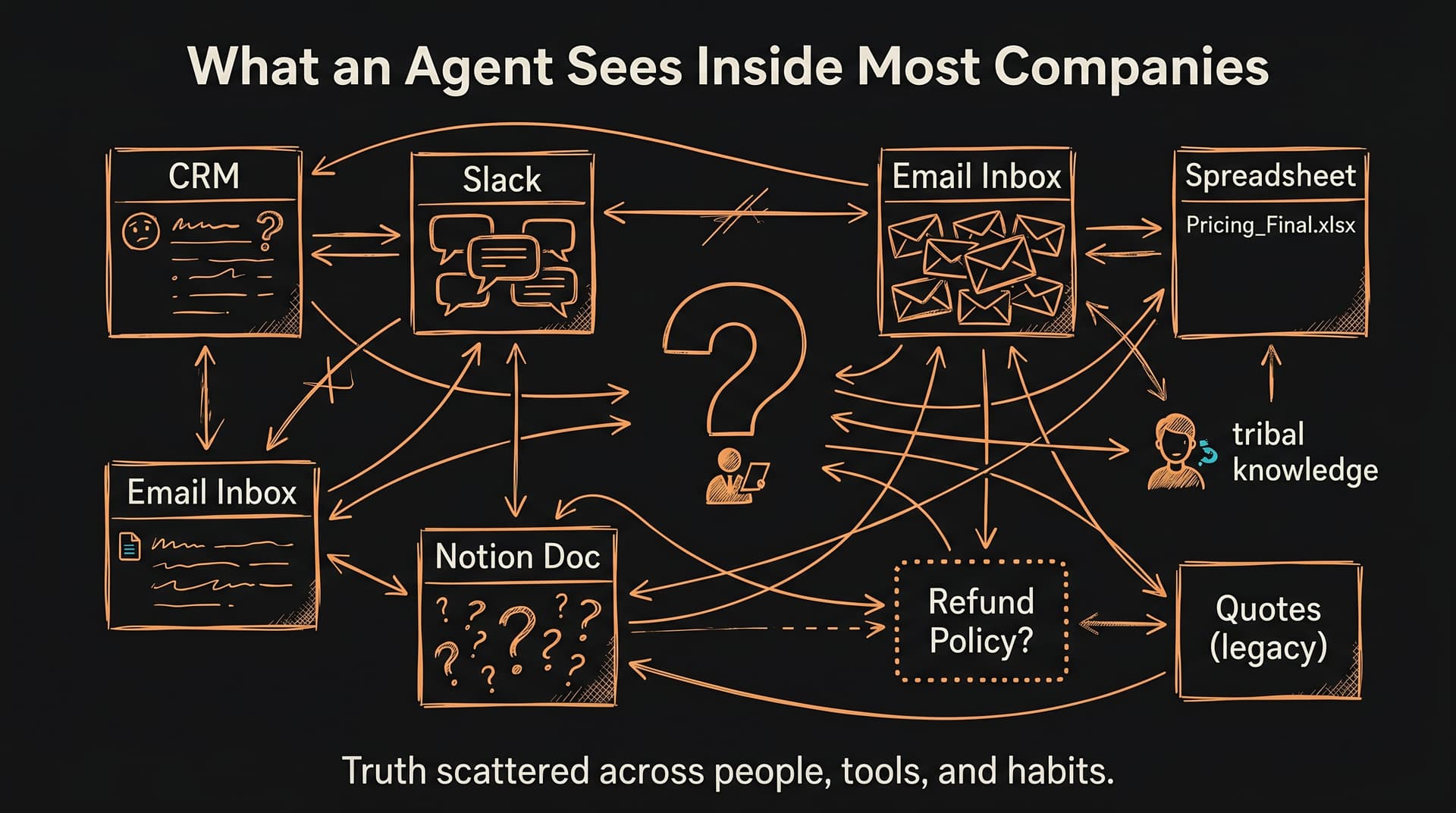
That last part is the sticking point for most organizations. The actual operating logic of most businesses — how a quote gets approved, what happens when a client asks for a refund, which customers get escalated and why — exists almost nowhere in written form. It exists in muscle memory, in Slack threads, in the tribal knowledge of senior employees who've been there long enough to know how things really work.
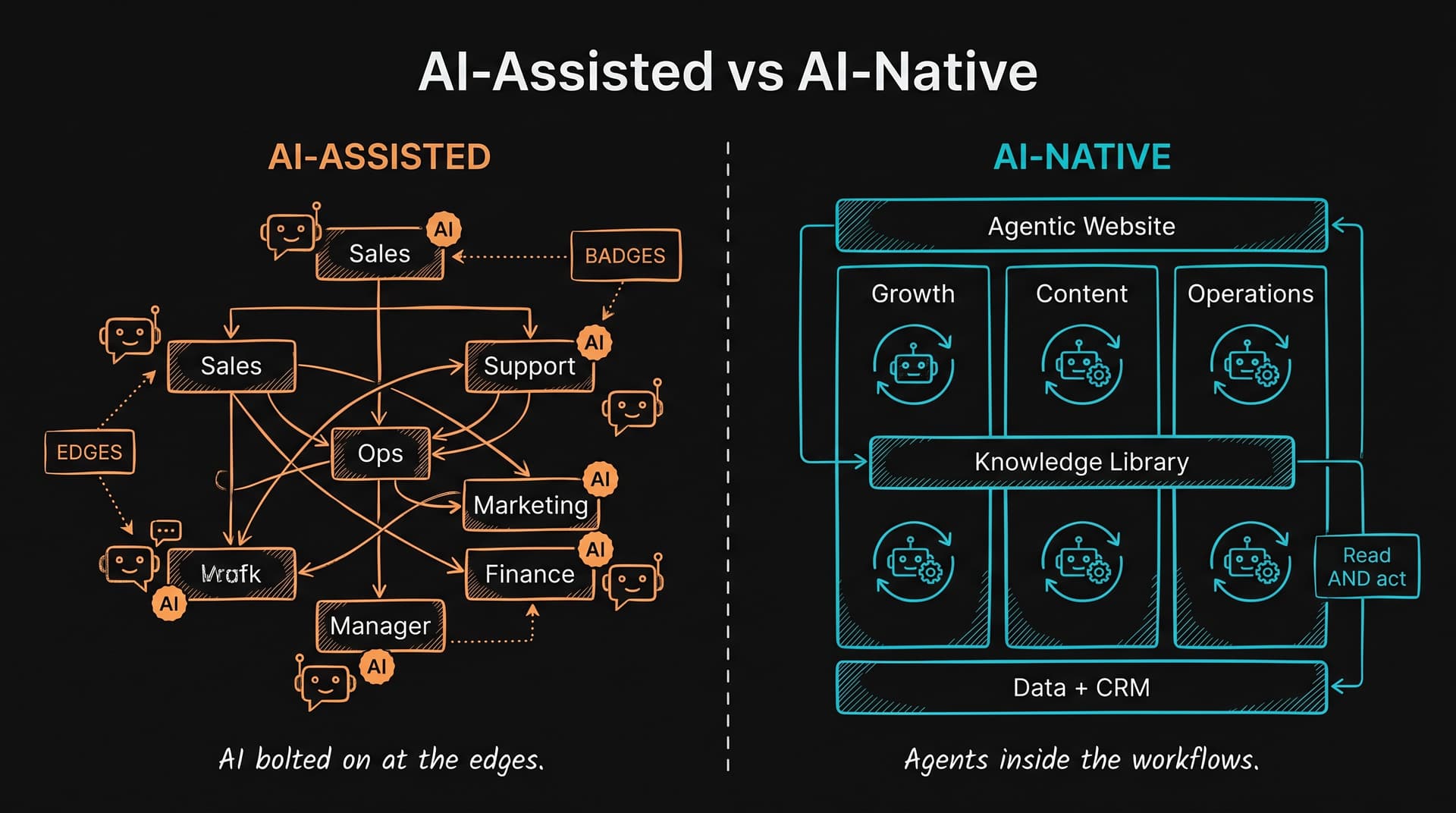
Agents can't work inside that kind of company. They have no context to work from. The knowledge isn't structured. The policies aren't written. The workflow isn't mapped. You can bolt a chatbot onto the front of it, but the business itself remains opaque to automation. That's AI-assisted. It's not AI-native.
AI-Assisted vs AI-Native: Edges vs Center
An AI-assisted company uses tools to augment human-driven processes. A salesperson uses AI to draft outreach. A marketer uses AI to generate copy options. A manager uses AI to summarize meeting notes. The human is still the center of every workflow. AI is the assistant at the edges — useful, time-saving, genuinely helpful. But the business runs because humans coordinate it.
An AI-native company redesigns the workflow itself around what agents can do autonomously. Inbound leads are classified and scored before a human sees them. Briefs are drafted, routed, and returned for approval without manual handoff. Renewal schedules are generated from structured data, reviewed by one person, and sent. The human role shifts from executing the process to setting the rules, reviewing the outputs, and handling the exceptions. That is a different company — different in structure, different in economics, different in what it can scale.
A Day in the Life: Three Workflows, Rebuilt
Abstract definitions only go so far. Here's what the shift from AI-assisted to AI-native looks like in practice, across three types of businesses that might not seem like obvious candidates.
Regional Insurance Brokerage
- →Old way: A producer manually pulls renewal data from three systems, drafts comparison options in a Word doc, emails it to the client, and follows up by phone ten days later.
- →New way: Ninety days before renewal, an agent pulls the client's current coverage, runs it against current market options, drafts a comparison memo in the firm's format, and queues it for producer review. The producer approves and sends. The follow-up sequence runs automatically. The producer's job becomes judgment and relationship — not data assembly.
Home Services Company
- →Old way: Every inbound call or web form goes to an office manager who asks qualifying questions, checks the schedule, ballparks a price, and schedules a visit — a process that takes 8–15 minutes per lead and requires someone available to answer.
- →New way: An intake agent classifies the job type, asks the structured questions that determine scope, checks the pricing table, generates an estimate range, and books the assessment slot. High-complexity jobs escalate to a human. The office manager handles the exceptions, not the routine.
Small Marketing Agency
- →Old way: A strategist takes client notes from a kickoff call, writes the creative brief manually, shares it in Slack, waits for feedback, revises, and finally hands it to the creative team — a process that takes two to three days and bottlenecks on the strategist's availability.
- →New way: The kickoff call transcript feeds into an agent that extracts structured brief data against a defined template, flags gaps, drafts the brief, and routes it to the strategist for a 15-minute review. The CRM is updated automatically. The strategist's time is spent on the hard parts — not the assembly.
None of these are science fiction. All three require the same foundational work: the pricing logic is written down, the qualification criteria are defined, the brief template exists, and the routing rules are explicit. That's the machine-legibility prerequisite. You can't automate a process that no one has ever formally described.
Why the Field Is Nearly Empty
The market is not full of AI-native companies. It is conspicuously empty of them. MIT Project NANDA research published in 2025 found that 95% of enterprise generative AI implementations show no measurable impact on P&L. The researchers cited a consistent root cause: AI layered on top of existing workflows rather than embedded in them.
That finding reflects something observable in practice. Most organizations are not structured in a way that agents can navigate. The business logic is implicit. Pricing exists in a spreadsheet that only one person fully understands. Refund decisions happen on a case-by-case basis, adjudicated in a Slack DM. The exceptions — which are actually quite common — live in the head of the senior account manager who has been with the firm for seven years.
In other words: even the humans inside the business struggle to fully read it. An agent has no chance.
The companies that do become AI-native don't succeed because they found better tools. They succeed because they did the unglamorous infrastructure work first: documenting the policies, defining the escalation triggers, structuring the knowledge base, writing down the judgment calls that previously existed only in people's heads. That work is hard, it is slow, and it looks nothing like an AI project. Which is exactly why most companies skip it — and why the field stays nearly empty.
The Boring Opportunity
While the conversation in tech media circles around foundation models and AI startups, the real opportunity is hiding in plain sight. Agentic AI — systems where agents take multi-step actions inside real workflows — is a market projected at $7.63 billion in 2025, growing at a 49.6% compound annual rate through 2033, according to Grand View Research. That growth is not happening primarily in software companies. It's happening in the service businesses that have been waiting longest for this kind of leverage.
Regional brokerages. Home services operators. Accounting firms. Recruiting shops. Legal and healthcare back offices. Property management companies. From the outside, these businesses look low-margin and operationally heavy. From the inside, most of their costs are coordination costs — people whose jobs are primarily to move information from one place to another, to track down approvals, to send reminders, to compile reports.
That is exactly the work agents displace. When you rebuild a regional brokerage's renewal workflow around agents, you don't need the same headcount to process the same volume. When you rebuild a home services company's intake process, you can handle more inbound with fewer staff — and respond faster. The economics of these businesses change. The margins start to look like software. And because the barrier to doing this work is primarily organizational (writing the policies, structuring the knowledge) rather than technical, the competitive moat for whoever does it first is real and durable.
The Playbook: How to Actually Become AI-Native
There is no shortcut past the infrastructure work. But the sequence is learnable, and it compounds fast once you start.
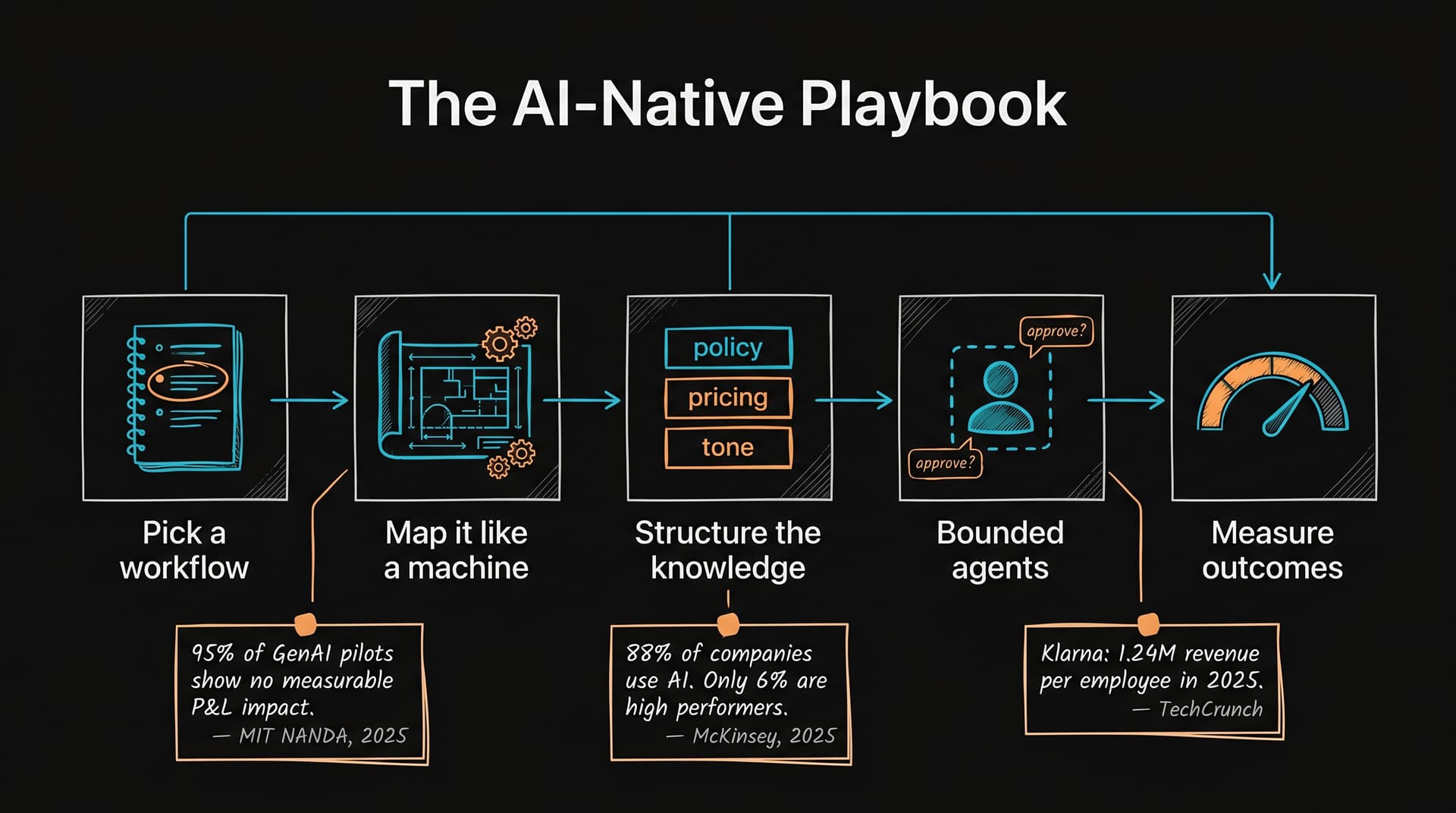
1. Pick a narrow workflow.
Do not try to transform the whole company at once. Find one workflow that is high-volume, rule-governed, and currently coordinated by humans who are mostly just moving information. Lead intake. Renewal outreach. Job quoting. Creative briefing. Invoice follow-up. Pick the one where the ROI is clearest if humans stop doing the manual parts.
2. Map it like a machine.
Document the trigger (what starts this workflow), the inputs (what information the agent needs), the decision points (what gets evaluated and how), and the escalation conditions (when a human must approve or intervene). This map does not need to be elaborate. It needs to be complete. Every time someone says "it depends" during this exercise, you have found a gap that must be filled before automation is possible.
3. Structure the knowledge.
Write the policy document. Define the pricing rules. Specify the tone, the escalation triggers, the edge cases, and the default behavior when the agent encounters something unexpected. This is infrastructure, not documentation. It is the substrate the agent reasons from. If it does not exist, the agent will hallucinate it — and that is not acceptable in a customer-facing workflow.
4. Put agents in with boundaries.
Deploy agents to handle the high-confidence, rule-clear tasks: drafting, classifying, routing, preparing, summarizing. Require human approval wherever judgment matters — pricing exceptions, client escalations, anything with legal or financial significance. Log every action. Review the logs regularly, especially in the first 90 days. The exceptions the agent surfaces will teach you where the rules need refinement.
5. Measure the business outcome.
The metric that matters is not hours saved. Hours saved is a proxy measure that rarely translates to the P&L directly. Measure resolution time, conversion rate, gross margin on the affected workflow, and revenue per person in the relevant function. If the number does not change, the implementation is not working — regardless of what the usage dashboards say.
What This Looks Like When It's Real: The Compounding Loop
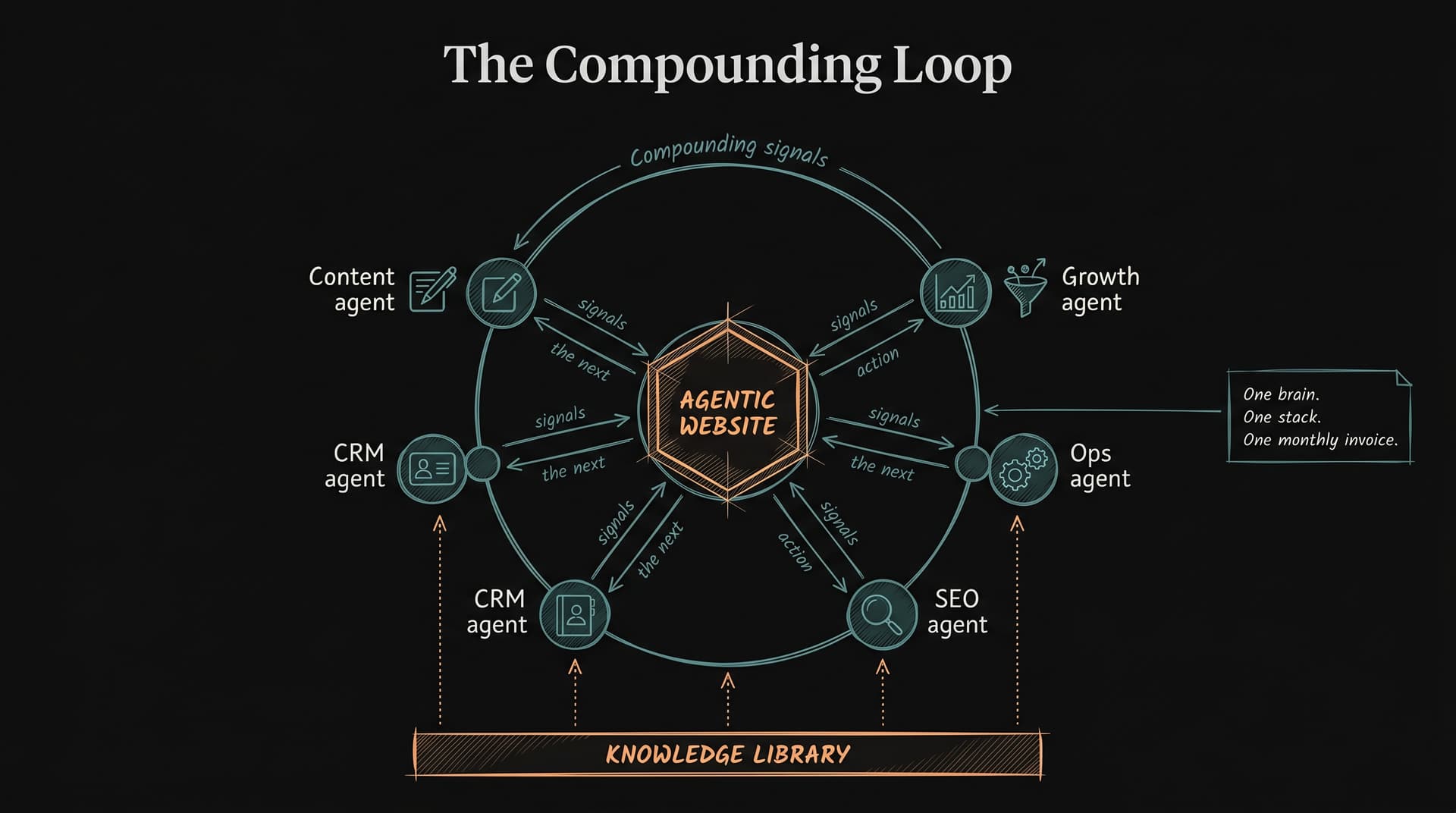
At gobigcreative.ai, this is the system shape we call AIOS — the AI-Native Business OS. The website is the hub. The chatbot is the conversation layer. Agents run content, growth, and operations. A knowledge library trains all of it. The CRM is one stop, not five.
But the concept behind it — a compounding loop — is the pattern worth understanding, regardless of the specific stack. When agents handle high-volume routine work, humans redirect their time to higher-judgment tasks. When those humans spend their time on higher-judgment work, the business produces better outputs. Better outputs improve the knowledge library that trains the agents. The agents get better. The loop reinforces itself.
The website as the brain of this system is not a metaphor. Every signal it receives — visitor behavior, conversion data, content performance — feeds back into the knowledge layer. Every asset the business publishes is an output of that knowledge layer. Over time, the gap between this kind of company and one still running on manual coordination becomes very wide.
The proof of concept exists at scale. Klarna rebuilt its operations around AI and reached roughly $1.24 million in revenue per employee in 2025 — up from around $575,000 the year before — while headcount dropped by nearly half and revenue more than doubled. Operating expenses rose just 2% in the same period. That is what the compounding loop looks like when it is fully operational. Not every company will reach those numbers, but the structural dynamic is not unique to Klarna. The same logic applies to any service business that can make its workflows machine-legible.
Frequently Asked Questions
What's the difference between an AI-assisted company and an AI-native one?
An AI-assisted company uses AI tools to help humans work faster — drafting, summarizing, generating options. The human still drives every workflow. An AI-native company has redesigned its workflows so that agents execute the routine steps autonomously, with humans reviewing outputs and handling exceptions. The difference is structural: in an AI-native company, the business processes are documented, rule-defined, and machine-legible enough for agents to operate inside them without constant human handholding.
How long does it take to actually become AI-native?
The honest answer depends on how much process debt you are starting from. For a company with reasonably documented processes and clean data, one narrow workflow can be rebuilt in six to twelve weeks — including the knowledge structuring work. For a company where most of the operating logic lives in people's heads and scattered systems, plan for longer, because the infrastructure work comes first. Most operators discover that the limiting factor is not the technology; it is doing the deliberate work of writing down how the business actually runs.
Do you have to rip out your existing software stack?
No. Most AI-native transformations happen on top of existing tools, not by replacing them. Your CRM stays. Your email platform stays. The shift is in how those tools are used — agents working within them rather than humans manually updating them. The more important question is whether your data is clean and accessible enough for an agent to read and act on. Fragmented, poorly structured data is the more common barrier than the specific tools in the stack.
Is AI-native only for tech companies?
The opposite is true. Technology companies have been automating high-volume processes for years and often have the least runway left. The biggest gains from becoming AI-native are in traditional service businesses — brokerages, home services, accounting, recruiting, legal and healthcare administration, property management — where coordination costs are high, margins are thin, and the workflows have never been systematically automated before. These businesses have the most to gain and, because the transformation is primarily organizational rather than technical, the barrier is lower than most operators assume.
The Bottom Line
The label "AI-native" has been applied so broadly it risks meaning nothing. But the thing it is supposed to describe — a company whose workflows are structured, documented, and instrumented enough for agents to operate inside them — is real, specific, and still rare. The 88% of companies using AI and the 6% achieving meaningful returns from it are not separated by technology. They are separated by organizational architecture.
The field is nearly empty. The work to enter it is unglamorous. But the compounding advantage it creates — in margin, in scale, in what the business can do per person — is not available through any other path. Pick one workflow. Map it like a machine. Build from there.
Ready to Build an AI-Native Business?
We work with operators who are ready to move past the tools and build the underlying system. If you want to identify which workflow to start with and what it takes to make it machine-legible, let's talk.