
The traditional website is a digital brochure. You build it, you publish it, and then it sits there while the world changes around it. SEO algorithms shift. User behavior evolves. Competitors run tests and improve. Your site does none of that — it just waits.
An AI-powered website is fundamentally different. It monitors, learns, and improves itself. This article explains exactly what that means in practice, why it matters more than ever in 2026, and how to know if your business needs one.
The Website You Built Is Already Aging
The build-and-forget era of web publishing is over. Three forces are accelerating the decay of static websites — and they're all hitting at once.
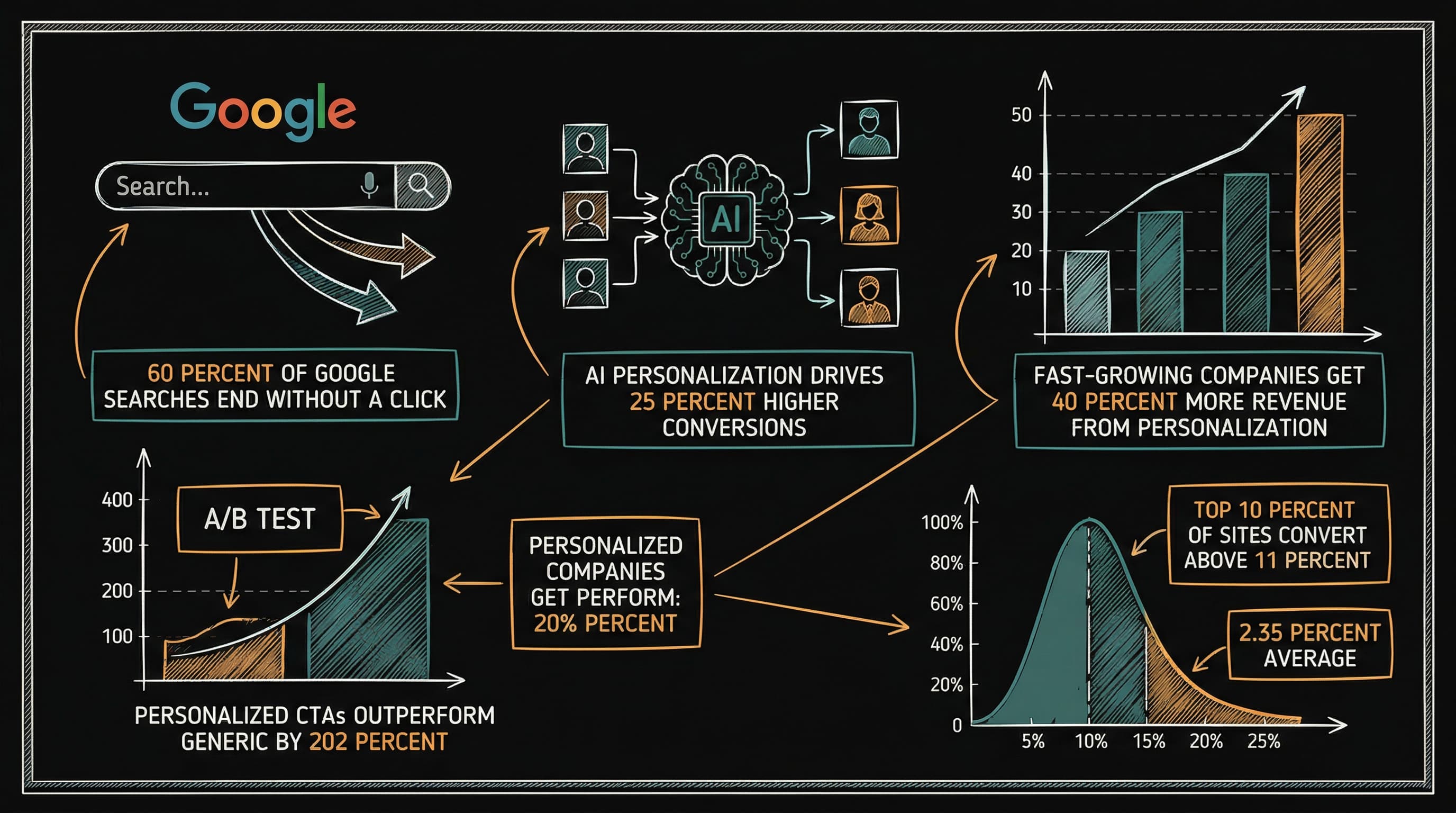
First: zero-click search. According to Fortune, 60% of Google searches now end without a single click to any website. Google answers the question in the results. Your traffic never materializes, no matter how well you rank.
Second: AI search cannibalization. ChatGPT, Perplexity, and Gemini are absorbing billions of queries that used to flow to websites. McKinsey estimates that 20-50% of traditional web traffic is at risk, with $750 billion in revenue at stake by 2028.
Third: compounding competitor advantages. Every business running continuous A/B testing, automated SEO monitoring, and behavioral optimization is pulling ahead — permanently. A site that gets better every month beats a site that stays the same, every time. The gap widens whether you're paying attention or not.
The Traffic Math Is Getting Worse
- →60% of Google searches end without a click (2024)
- →20-50% of traditional web traffic at risk from AI search (McKinsey)
- →20-40% traffic drops already reported by businesses with heavy AI search exposure (Kellogg Insight)
- →The sites surviving — and growing — are the ones that respond to change automatically
So, What Actually Is an AI-Powered Website?
An AI-powered website is a living system — not a document. It uses machine learning, behavioral data, and automated optimization to continuously improve its own performance across SEO, conversions, and user experience.
The contrast with a traditional site is stark. A traditional website is a digital brochure: you design it, you publish it, and it delivers the same experience to every visitor indefinitely. Updates happen when someone manually decides to make them — usually months or years apart.
An intelligent website operates differently. It watches how visitors behave, identifies what's working and what's not, tests changes against real traffic, and implements improvements — automatically, continuously, without waiting for a developer to have bandwidth.
The analogy that resonates with most business owners: a traditional website is like hiring a graphic designer to build a store, then locking the layout in place forever. An AI-powered website is like having a data scientist and a conversion specialist on staff 24/7, always running experiments, always improving.
What Does an AI-Powered Website Actually Do?
Five capabilities separate an intelligent website from a static one. These aren't theoretical features — each one translates directly to measurable business outcomes.
1. Real-Time Personalization
The site serves different content, headlines, and offers based on who's visiting. A returning customer from a specific industry sees a different homepage than a first-time visitor arriving from a Google ad. Content adapts to device, location, referral source, and behavioral history.
71% of consumers expect personalized experiences. Personalized CTAs outperform generic ones by 202% (Contentful).
2. Continuous A/B Testing
Rather than running one test at a time when someone thinks of it, an AI-powered website continuously experiments across headlines, button copy, layouts, and CTAs. Traffic is split automatically. Winning variants are deployed without human intervention. Losing variants are retired.
The top 10% of websites convert above 11%. The average site converts at 2.35%. That gap is largely explained by systematic testing.
3. Behavioral Analytics and Pattern Recognition
The system tracks micro-behaviors — scroll depth, hover patterns, click sequences, exit intent — and surfaces insights that are invisible to manual analysis. It identifies friction points before they show up in your bounce rate, and flags conversion leaks before revenue is lost.
4. Automated SEO Monitoring and Improvement
Rankings change. Algorithms update. Competitor content appears. An AI-powered website monitors all of this continuously — flagging technical issues, identifying keyword gaps, suggesting content updates, and implementing on-page fixes without waiting for a quarterly review.
This is especially critical in 2026 as AI-powered SEO has shifted from an advantage to a survival requirement.
5. Predictive Conversion Optimization
Beyond testing what's happened, AI models predict what will happen. Which visitors are most likely to convert? What's the optimal time to show an offer? Which page sequence drives the highest purchase intent? The system routes visitors accordingly — in real time.
Why Traditional Websites Are Becoming Obsolete
The problem isn't that traditional websites are bad. They were fit for purpose when the web was simpler. The problem is the environment they operate in has fundamentally changed.
AI search is the most immediate threat. As ChatGPT, Perplexity, and AI Overviews absorb search intent, sites that don't continuously optimize for these new surfaces will simply stop being discovered. The businesses that survive this shift are the ones with dynamic, AI-readable, regularly updated content — not static pages that haven't changed since 2023.
The traffic decline is already measurable. Kellogg Insight documented 20-40% organic traffic drops for businesses heavily exposed to AI search. For those businesses, the question isn't whether to adapt — it's whether they'll adapt fast enough.
Then there's the compounding advantage problem. A competitor running continuous website optimization in January will be measurably ahead by June. By December, they're operating a conversion machine built on thousands of data points from real visitors. Your static site is exactly where it was in January. This gap doesn't close — it accelerates.
The Business Case — What the Numbers Say
This isn't a philosophical argument about the future of the web. The ROI case for AI website optimization is concrete and well-documented.
Personalization Revenue Impact
- →AI personalization drives 25% higher conversions on average (Salesforce)
- →Fast-growing companies earn 40% more revenue from personalization than slow-growing peers (McKinsey)
- →AI increases conversion rates by up to 20% through predictive attention optimization (Dragonfly AI)
- →Amazon's AI recommendation engine drives 35% of annual sales — built entirely on dynamic website optimization
Real Brand Results
- →North Face: 60% CTR increase from AI-driven product personalization
- →Sephora: 11% conversion boost from AI-powered site personalization
- →Personalized CTAs outperform generic CTAs by 202% (Contentful)
The math is consistent across industries: businesses that use AI to continuously improve their websites convert more visitors, retain more customers, and grow faster than those operating static sites. The question is whether you're the business doing this — or the one watching competitors pull ahead.
What GoBig's Brain AI Websites Do Differently
I've seen a lot of agencies claim they build "AI websites." Most of what they're describing is a fast site with decent SEO — which is necessary, but it's not the same thing.
GoBig's Brain AI Websites are built on a different premise: the site should be a self-improving system from day one, not a static deliverable you hope stays relevant. The core pitch is direct — AI-powered websites don't just sit online. They fix themselves, improve SEO, and boost conversions automatically.
Here's what that looks like in practice:
Automated SEO and CRO Improvements
The site audits itself continuously. Technical issues, keyword gaps, and conversion friction are flagged and addressed on an ongoing basis — not when someone schedules a review.
Human-in-the-Loop Quality Control
Automation doesn't mean no oversight. Every significant change goes through a review process before it goes live. You get the speed of AI with the judgment of an experienced team — not a black box making unchecked edits to your site.
Enterprise-Grade Technical Foundation
Lightning-fast performance, Core Web Vitals compliance, and conversion-first architecture baked in from the start. The foundation doesn't need to be rebuilt later — it's built correctly the first time.
Real-Time Data Integration
The site connects to live data sources — CRM, analytics, inventory, customer behavior — so content stays current and personalization stays accurate.
Client Dashboard
You see exactly what the site is doing, what's improving, and what's being tested. No black box. Full visibility into the optimization work happening on your behalf every month.
Pricing starts at $1,500–$3,000 for the build, with monthly optimization starting at $500/mo. The way I think about it: you're not paying for a website. You're paying for momentum that compounds instead of decays.
A static site loses ground every month. A Brain AI Website gains it. Over 12 months, that difference is the gap between a site that's getting harder to find and one that's becoming your best sales asset.
Is an AI-Powered Website Right for Your Business?
Not every business needs a full AI-powered website today. But there are clear signals that you should take this seriously now rather than later.
Signs You Need an AI-Powered Website
- →Your organic traffic has been flat or declining for 6+ months
- →You're getting traffic but not converting it into leads or sales
- →Your site was last updated more than 12 months ago
- →Competitors seem to be pulling ahead in search visibility
- →You're spending money on ads to compensate for poor organic performance
- →You have no visibility into what's working on your site or why
If several of these apply, the first step is understanding where you stand. Our free SEO analyzer gives you an immediate read on your site's current performance — technical issues, SEO gaps, and conversion problems surfaced in minutes, not weeks.
From there, you can make an informed decision about whether incremental AI-powered SEO improvements are the right move, or whether you need the full self-optimizing system.
Frequently Asked Questions
What makes a website "AI-powered" vs. just having AI tools?
An AI-powered website uses machine learning as a core operating system — continuously monitoring performance, testing variations, and implementing improvements automatically. Having an AI chatbot widget or using an AI tool to write copy doesn't make a website "AI-powered." The distinction is whether AI is running optimization loops, not just assisting humans with one-off tasks.
How long does it take to see results from an AI-powered website?
Technical SEO improvements (Core Web Vitals, indexation fixes, structured data) often show measurable impact within 4-8 weeks. Conversion optimization results typically appear within 60-90 days as the system accumulates enough behavioral data to make confident optimizations. Meaningful organic traffic growth from continuous content and SEO work compounds over 3-6 months.
Does my business need to be large to benefit from AI website optimization?
No. The ROI case is strong for businesses of all sizes, because the comparison isn't "AI vs. your current team" — it's "AI vs. leaving your site static." A 25% conversion lift on modest traffic is still meaningful revenue. The entry point for AI-powered websites has dropped significantly; it's no longer enterprise-only technology.
Will an AI-powered website hurt my brand voice or content quality?
Not if it's implemented with human oversight. The risk of fully autonomous AI publishing is real — brand drift, factual errors, off-tone content. That's why human-in-the-loop review is a non-negotiable part of any serious AI website system. AI generates and tests; humans approve before anything significant goes live.
What's the difference between AI website optimization and just hiring an SEO agency?
A traditional SEO agency conducts periodic audits and makes manual updates. AI website optimization is continuous — monitoring, testing, and improving 24/7 between human review cycles. The output is faster iteration, more experiments run, and optimization decisions based on your actual visitor data rather than industry benchmarks. It's not either/or; the best results come from AI systems guided by experienced human strategy.
The Bottom Line
The web isn't waiting for your next redesign cycle. Zero-click search is eating organic traffic. AI assistants are intercepting queries before they reach your site. And competitors running continuous optimization are compounding their advantages every month you stay static.
An AI-powered website isn't a luxury upgrade. In 2026, it's the baseline for any business that wants to compete for online visibility. The good news: you don't need to rebuild everything at once. You need to start moving.
Start with a clear picture of where you stand. Run the free audit. See what your site is actually doing — and what it's costing you by staying static.
See What Your Site Is Costing You
Get an instant read on your site's SEO health, conversion gaps, and technical issues — free, in under 2 minutes. Or talk to us about building a website that improves itself.